
 #FreeAllWords: International Text and Translation Fund of the European Writers‘ Council (EWC) gives a voice to authors from Belarus and Ukraine

Shouldn’t we be talking more about public lending right?
On 23 and 24 September, the European Writers’ Council (EWC) co-hosted the PLR International Conference in Paris, bringing together over 50 representatives, including from nine EWC organisations and the global book and literacy sectors to discuss a right that we may not always have enough in mind: public lending right (PLR).

- PLR is the right for authors to receive a payment for the use of their works in libraries.
- PLR is a key mechanism for ensuring that libraries can foster literacy through an offer of diverse, high-quality books, written and translated under fair conditions.
- PLR is a commitment to fairness – but only 33 countries have PLR-systems in place. Neither in the U.S., nor in Latin America or Africa this fairness is established.
- PLR is, where it is functioning and with a decent budget by the State, an essential part of authors’ remuneration and income.
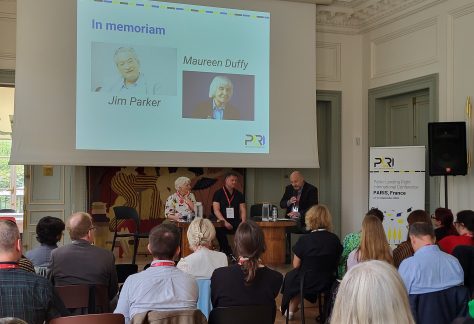
- As Maureen Duffy, whom we had the opportunity to remember and honour during the conference alongside Jim Parker, both beloved and missed PLR Champions, used to advocate:
“No use without payment!”
The 1,5-day-conference of PLR International, of which the EWC is a founding member, addressed issues such as fair remuneration, the diversity of but also fragmented PLR systems around the world, and how these systems can provide social support for authors, too.




The Conference Day was filled with six break-out sessions, expert’s Q&A about transparency, economic systems and the different legal regimes of PLR, alternating with interactive panels to facilitate deep dive exchange among the participants. The concept of what is defining a library was as much debated as who is eligible to benefit from library money – and who and why not.
Panels and talks were brilliantly moderated by Nina George, EWC Commissioner for Political Affairs, and Nicole Pfister Fetz, PLRI Board Member and EWC Secretary General.
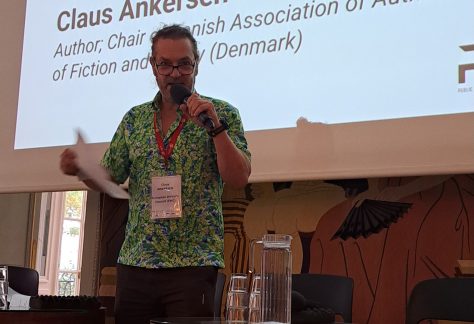
The keynote speech by Claus Ankersen, Danish poet, writer, and EWC Board Member, brought back what the readers’ quest used to be: a transcendental act. His plea: bring back diversity into library collections, to allow the next generation to discover the “Chamber of Secrets”, instead of outsourcing thinking, reading, and writing, to “AI”.
EWC President Sebastià Portell and EWC Vice President Maïa Bensimon attended the different events as delegates.
We were also happy to exchange with our EWC Members from Estonia, Finland, France, Iceland, Ireland, North Macedonia, Norway, Sweden, and United Kingdom.

We send a “gros merci!” to PLR International for having us, to La Sofia for the perfect hospitality, Stichting Leenrecht for the organisation, and to the team at the Hôtel de Massa for welcoming authors, publishers, CMOs and everyone attached to PLR into a space so rich in both history and present-day life. The spirit of those who once pioneered the concept of ‘authors’ rights’ can still be felt in this building: In 1929, the Société des Gens de Lettres, a society founded in 1838 by famous writers including Honoré de Balzac, Victor Hugo, Alexandre Dumas and George Sand, moved in, and hosts letters and manuscripts by authors who have marked the history of French Literati.