 #FreeAllWords: International Text and Translation Fund of the European Writers‘ Council (EWC) gives a voice to authors from Belarus and Ukraine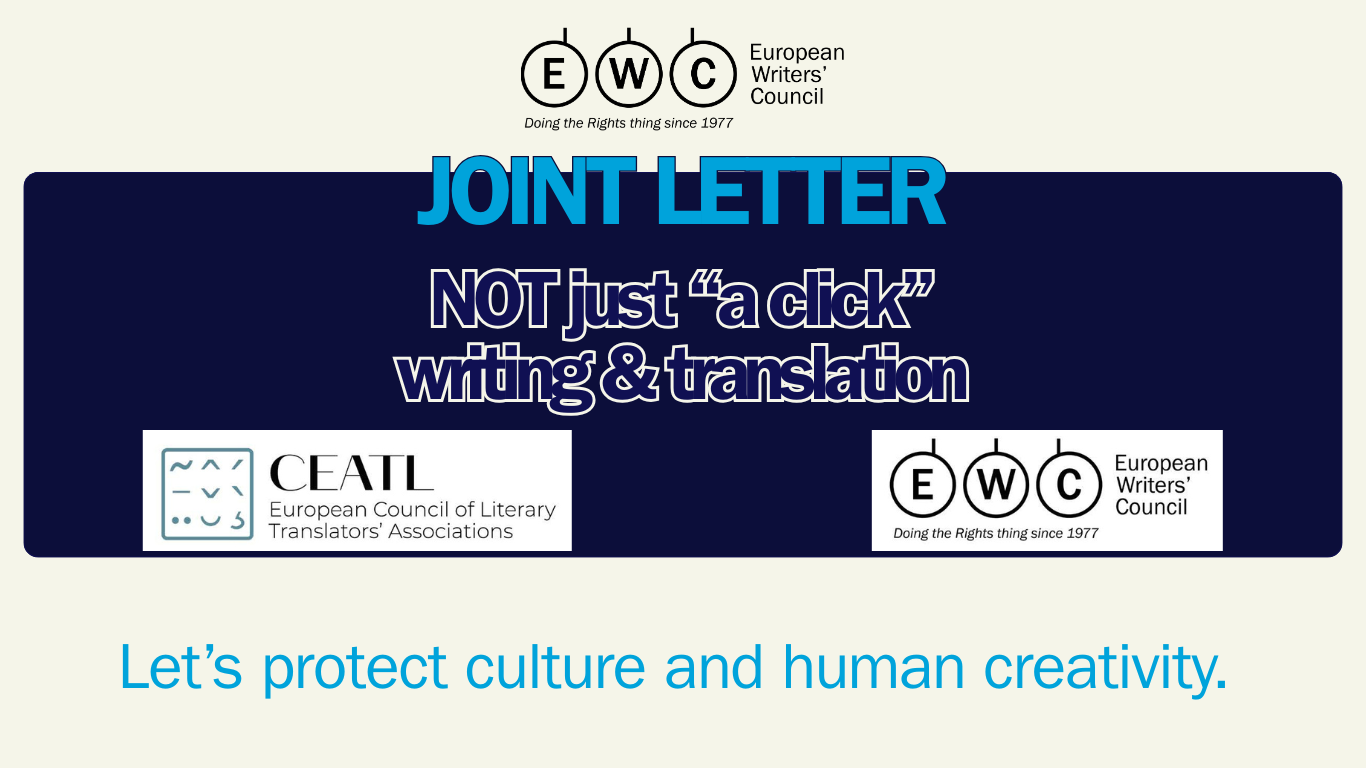
Joint Statement by EWC and CEATL to call on the global book sector, including writers, agents, publishers and readers, to stand in solidarity with human literary translators.
Let’s protect culture and champion rich human creativity.Let’s defend ourselves against the logics of mere profit. Let’s keep fostering an industry that nurtures a love of reading of works written, translated, illustrated and published by human beings.
Books cannot be translated in a click!
We are deeply troubled by the recent announcement from Amazon to launch Kindle Translate, a new AI-powered translation “service”, for Kindle Direct Publishing (KDP) authors. Currently in beta, Kindle Translate will initially offer translation of e-books between English and Spanish and from German into English, to selected KDP authors for free.
What’s it about?
Kindle Translate promises to:
- “Create publication-ready translations in a few days, for free.”
- “Preview quality of translations before publication.”
- “Reach new readers worldwide and earn more royalties.”
What is going to happen?
This is another blow to literary translators (fiction and nonfiction alike), whose profession is being increasingly threatened by AI: from Audible’s recent announcement to launch a new automated translation service for audiobooks to Dutch publisher Veen Bosch & Keuning’s announcement that they will use AI to translate books into English, the ease with which translators seem to be removed from the translation process in favour of AI services and tools is incredibly worrying and should be a wake-up call for all players in the global book sector.
Why are we concerned?
Writing a book takes intense labour time, life-long development of craft, and highly professional skills and creativity. The same applies to the translation of a book: the skills, crafts and expertise of translators are instrumental in the creation of high-quality translations, which respect the writer’s sense of storytelling and style as well as enrich the reader’s experiences.
AI does not translate, it merely generates textual material. And: most AI models have been unlawfully trained on copyright-protected works without consent, attribution or remuneration of the writers and translators. Many AI-powered translation services claim to provide perfectly accurate translations but there is no such thing. A literal translation is the opposite of a good translation.
What does this threat take away from all of us?
Imagination, creativity and sensitivity are intrinsically human. AI does not grasp humour and metaphors, cannot experience the emotions, nor interpret the intention behind the words. On the contrary, it flattens and impoverishes texts and stories, and reports suggest that it reinforces biases and stereotypes, and increases the risk of inaccuracies and errors. Every author must be aware that a machine translation might harm their text, style, and hence their reputation. Additionally, AI raises many questions in terms of accountability of the automated, non-protected output that is remixed and generated by an AI model.
What do we call for?
CEATL and EWC call on the global book sector, including writers, agents, publishers and readers, to stand in solidarity with human literary translators.
Let’s protect writers’ and translators’ work, their diverse creativity and their livelihood.
Let’s protect culture and champion rich human creativity.
Let’s defend ourselves against the logics of mere profit.

We, CEATL and EWC, represent around 260.000 individual authors and translators from 91 associations in the book and text sectors, who work as writers and literary translators in all genres in Europe and beyond.
Brussels, 24 November 2025
European Council of Literary Translators’ Associations (CEATL)
European Writers’ Council (EWC)
PDF: Joint Letter CEATL&EWC on KindleTranslate
ABOUT THE SIGNATORIES
CEATL (European Council of Literary Translators’ Associations) is an international non-profit organisation created in 1993 as a platform where literary translators’ associations from different European countries could exchange views and information and join forces to improve status and working conditions of translators. Today it is the largest organisation of literary translators in Europe with 38 member associations from 30 countries, representing some 12.000 individual literary translators. https://www.ceatl.eu
EWC (European Writers’ Council) is the world’s largest federation representing solely authors from the book sector and constituted by 53 national professional writers’ and literary translators’ associations from 34 countries, from European Union Member States, the EEA countries, Iceland and Norway, as well as Belarus, Montenegro, North Macedonia, Switzerland, and the United Kingdom. EWC members comprise over 250.000 professional authors, writing and publishing in 37 languages. europeanwriterscouncil.eu