
 #FreeAllWords: International Text and Translation Fund of the European Writers‘ Council (EWC) gives a voice to authors from Belarus and Ukraine
Brussels, 27th April 2026
PDF Statement: Study on Discoverability
The malicious Power of Algorithms:
How Amazon & Co control European authors, stories, and topics
How do readers in Europe discover their new favourite writers?
How – and by whom – are buying decisions influenced, and what role do non-European monopole companies, and their opaque algorithms, play in the (in)visibility of books written by European authors?
Deep and partly worrying insights are now provided by the Study “On the discoverability of diverse European cultural content in the digital environment”, commissioned by the European Commission and its Directorate-General for Education, Youth, Sport and Culture, under the EU Work Plan for Culture 2023–2026.
Alarming Study on Discoverability
The final report examines how European cultural works – with a strong focus on the book sector and the music market – are discovered and accessed in today’s digital environment, with particular attention to the role of (non-European) platforms, non-transparent algorithm curation, and biased recommender systems. With 22 policy recommendations, the Study calls for concrete action.
11 Key Findings
For the authors of the book sector, these 11 key findings are crucial:
Access to Attention: Who are the gatekeepers for European works in the digital area?
- The individual challenges of writers have shifted: It is easier to get published than to be discovered in the digital environment. The platformisation of cultural discovery leads to the fact that a small number of global tech companies (e-book and audiobook platforms, social media and video-sharing sites, online stores) mediate a large share of the literature consumption in the European sector.
- Access to attention is influenced by the gatekeeper-function of non-European platforms. Amazon and Goodreads leave EU authors underrepresented, while EU-specific or local platforms often lack scale.
- Opaque recommender algorithms favour popularity and monetary success, making less successful books, niche topics, or works from smaller countries and “minoritised languages”, invisible. The algorithm “learns” that mainstream content yields more clicks and thus keeps promoting mainstream.
- Readers show strong openness to English-language books (over 85%), amplified by social media platforms like BookTok, at the expense of Europe’s linguistic diversity. At the same time the survey’s evidence shows that younger readers are more open to exploring new genres and non-national works than older readers.
No fan-base – no sales?
- Translation gaps and high costs limit cross-border circulation, while the affordability and prevalence of English-language editions further reinforce linguistic imbalances.
- The need for author visibility places increasing demands on the creation of personal branding and growing a social media presence, often disadvantaging non-hegemonic languages and smaller-market authors without access to infrastructure of self-promotion. A solid “fan base” is, in some book markets, the main ticket for publication.
- Gender diversity remains uneven, with women underrepresented in bestseller lists and recommendations.
Money can buy love. Metadata and labelling of AI bogus books are a solution, too.
- Inconsistent use of metadata standards hinders visibility, especially for smaller publishers. Without a smart ONIX, a book remains lost on the digital shelves.
- The flood of non-labelled AI-generated bogus books, thousands per day on Amazon, intensifies the competition for attention and takes away visibility of human writers.
- Without a significant budget for online presence by their publisher, new authors are stuck with digital invisibility.
- E-book flat-rate schemes, or e-lending in libraries, play a minor role in the discovery of new or European works and authors.
EWC comments on the findings
“Online marketplaces for books are no longer a neutral infrastructure. The dominance in Europe, particularly of Amazon, has become a controlling force over authors and literature, and is therefore a cause for democratic concern,” comments Nina George, EWC’s political Commissioner, on the findings. “As the study demonstrates, the control of books – and thus of authors – is inherent in entirely opaque ‘internal policies’ that follow the worldview of a company known to be a supporter of the diversity-phobic US government.”
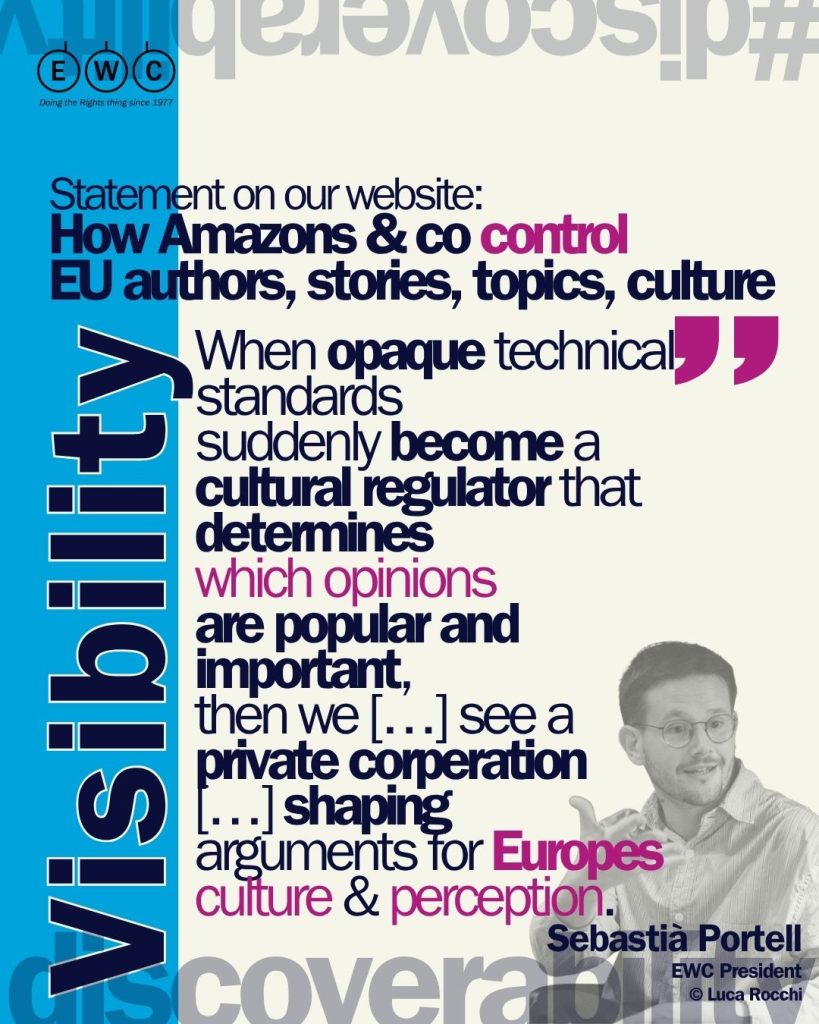
“Which ideas, voices and stories become visible today, are purchased and thus disseminated and accepted, should not be controlled by a non-European company,” confirms EWC President Sebastià Portell. “When opaque technical standards – be they purchase recommendations or the internal content control of a profit-driven company – suddenly become a cultural regulator that determines which opinions are popular and important, then we are dealing with more than just a bookshop. A private corporation should not shape what kinds of arguments are allowed to circulate in the European sphere. Here we see that decision makers have a duty to take swift action.”
Recommendations (not only) for Politicians how to act
The EWC especially welcomes these recommendations for policy action:
- Ensure accountability and authenticity in a generative AI era – and develop reliable obligations for the transparency of bogus AI books.
- Study in-depth the further impact of AI generated content and algorithmic bias, filter bubbles, and the drivers behind these technologies, not only with respect to discoverability, but also on culture and book markets.
- Encourage transparency in recommendation algorithms: platforms should share information about how their recommendation engines rank or curate cultural works with regulators, researchers, and creators.
- Strengthen cultural curation and explore content prominence mechanisms: digital platforms should be encouraged to actively curate and highlight diverse European content, rather than relying solely on automated popularity-based feeds. Prominence guidelines to foster the visibility of European works could be considered in a permanent EU multi-Stakeholder forum on discoverability.
- Integrate discoverability in all EU cultural policy actions and in the future EU Work Plan for Culture post-2026, e.g. in the Culture Compass for Europe plus the AI strategy for the cultural and creative sectors.
- Launch awareness campaigns on Europe’s diverse works, including a definition framework with monitoring, data collection and improving cultural statistics, for building up cross-border cooperation, but also via multi-lingual discovery portals.
- Digital and AI literacy for readers: digital and AI literacy programs should teach users how to take control of their content discovery online and have awareness of algorithmic curation across platforms.
About the European Writers’ Council (EWC)
The EWC is the world’s largest federation of writers in the book sector and of all genres (fiction, non-fiction, academic, children’s books, poetry, etc.). With 52 organisations and professional guilds from 34 countries of the EU, the EEA and of non-EU areas, the EWC represents 250.000 writers and translators, writing and publishing altogether in 37 languages. The EWC is the world’s leading federation for the defence of book authors’ rights since 1977.