
 #FreeAllWords: International Text and Translation Fund of the European Writers‘ Council (EWC) gives a voice to authors from Belarus and Ukraine

On 22-23 September 2026 the launch took place of a new initiative of the European Commission: the European Literacy Coalition.
Earlier in the year, dozens of literacy organisations and partners, including the European Writers’ Council (EWC), had met in Warsaw to workshop the key goals and methodologies of a European-wide coalition to address the challenge of declining literacy. The resulting Warsaw Memorandum is the foundational document of the new coalition and the ‘guiding light’ for the EU in this challenge.
The launch consisted of a number of presentations and workshops:
Keynote
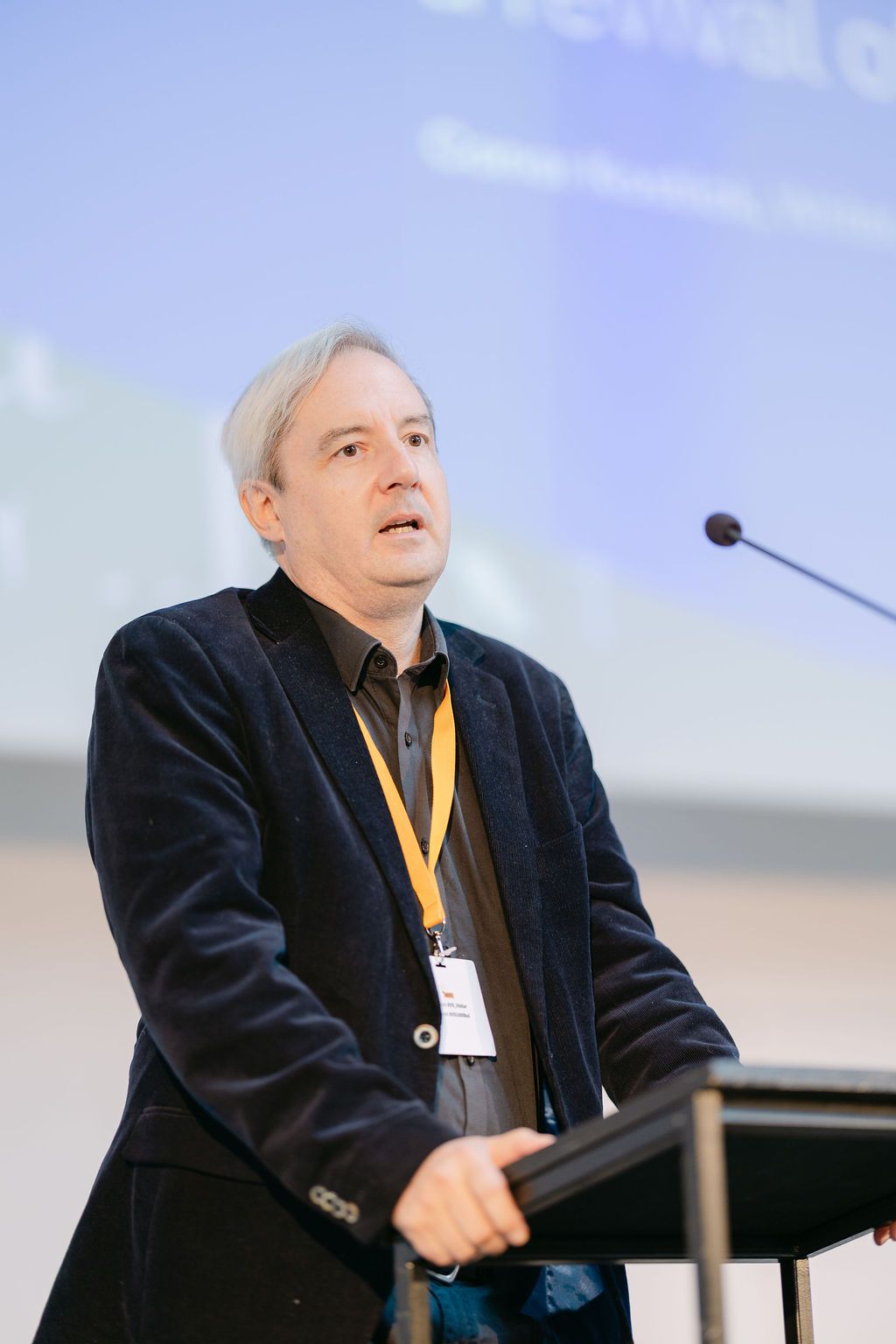
Representing the EWC, Conor Kostick gave the opening address (see below) and was followed by Normunds Popens, Deputy Director-General, Directorate-General for Education, Youth, Sport and Culture, European Commission, who gave support to the coalition and said that the EU will use the Warsaw Memorandum as a guidelight. Emmi Jäkkö, Director, Lukukeskus – The Finnish Reading Centre, spoke about how the recent Programme for International Student Assessment (PISA) results are worrying and reminded those present of how schemes to give books to every child at birth are successful. Andreas Galanos, Teacher, Experimental Senior High School of the University of Macedonia, said that there was hope in this coalition and especially in its breadth; she added that the Memorandum skilfully incorporates all those perspectives.

Literacy as a Public Good and Shared Responsibility:
Orlaith O’Connor, Deputy Chief Inspector, Department of Education and Youth, Ireland also referred to PISA results and explained the Irish approach that all teachers, not just Irish and English specialists, have responsibility for literacy. Pierre Tardieu, Chief Policy Officer, WindEurope, gave a business perspective: Energy is political and because misinformation by non-European actors is a threat, European business needs critical citizens as well as literary skills for the workforce.
Literacy Ecosystems as a Backbone of a Literate Europe:
Klaas Gommers, Policy Advisor, Dutch Association of Public Libraries gave an example of how libraries have gone out to leaflet communities and also made the point that in Ukraine libraries allow people to escape stress into books. Anne Mangen, Professor at the Norwegian Reading Centre, University of Stavanger said
…that AI is dangerous because we are inclined to use the easier option; there is an assault on children’s attention.
Daniela Marmocchi, Events and International Guest Relations Manager, Bologna Children’s Book Fair endorsed the value of the coalition, while Maja Meissner-Filipek, Founder, Meissner & Partners, Poland warned that
the coalition should not blame parents for failing to read to children.
Natalia Miteva, Former Deputy Minister of Education and Science, Bulgaria argued that
we need to teach AI literacy skills.
Closure:
Diana Jabkońska, Director for Youth, Education and Erasumus+, D-G for Education, Youth, Sport and Culture, European Commission said that after very worrying PISA results
the voice of the coalition will be heard and is very timely.
She stated that the EU would do everything to accompany this process, scaling up the most important practices.
Organisations can join the Coalition
The European Literacy Coalition is open to organisations working on literacy across all sectors, including those active in digital, media and AI literacy. Interested organisations can join by completing this form.
Keynote Address by Conor Kostick, EWC Board Member:
++Please note: All copyrights within this keynote text belongs entirely to the author, Conor Kostick. If you want to quote it, please add the link to the EWC original source website. If you want to re-publish the text, please ask the author for permission and further conditions.++
Thank you on behalf of the European Writers Council for giving voice to authors at the start of this landmark event and also my personal thanks for this invitation and opportunity to be part of a coalition that addresses one of the major challenges of our times: declining literacy and the political consequences of that.
The decline in literacy has far-reaching harmful consequences for society. When we read fiction, we meet other minds and we gain empathy for other people. When we care about a character we are strengthening our capacity to care for the stranger. Although social media appears to connect us to other people, it is not a meeting of minds, it is not an empathetic experience and if scrolling through memes and clips is replacing reading, far from bringing people together, social media becomes a severing of connection, a means of atomising us.
Even in countries with a very high formal level of literacy, near one hundred per cent, we cannot be complacent if reading for pleasure is in decline, because that means the community around the empathetic reading experience is also in decline.
Living in 2026 feels to me like living inside the story of the Sorcerer’s Apprentice.
There are innovative processes at work that of themselves are not necessarily harmful, but when they have global momentum and little regulation they become frenzied and dangerous, with a decline in reading for pleasure one of several manifestations of the harm. The recent PISA figures so one in two fifteen-year-olds in Germany only read when required. The growing crisis requires intervention. I hope that by the bringing together of a coalition to promote literacy and reverse this trend, we are a turning point in the story of reading equivalent to the return of the sorcerer.
To be clear about the analogy though, I’m not referring to the famous Disney version of the story, because the underlying message there is the unfair one that the young should not experiment with magic and the relationship of the sorcerer to the apprentice is a paternalistic one. Rather, in Goethe’s and earlier versions of the story the crisis leads to a learning experience by a student who will one day surpass the master. This is how I see our role: alerted by the data on declining literacy we are stepping up to re-inspire the world with the pleasure of reading and the development of a culture that encourages readers to take ownership of that pleasure and find time for it despite the frenzied pace of life in the 2020s.
There are already solutions to our challenge to draw on and we heard about them when this coalition gathered in Warsaw, solutions that emphasised meeting people in the spaces of their lives where they feel passionate about some aspect of contemporary culture and providing reading experiences to enhance that passion. There is tremendous expertise in this coalition and broad partnerships that mean it has every chance of turning the trend around.
Moreover, in an age in which more and more writing, film and music is being generated algorithmically, I sense a growing upsurge of demand for human created works.
I take heart from the world of chess. Chess has had decades to come to terms with computer expertise and what has happened there is instruction and encouraging. Back in 1997, Deep Blue beat the reigning world chess champion Gary Kasparov and ever since taking the lead over humans the gap between them and humans has widened. There is no question that today the most accurate chess is played by machine.
Earlier this year two well-promoted chess games were put online. One of them featured the two top chess computers playing against each other. It has 9,300 views. The other featured Magnus Carlsen playing an arch-rival. It has 1,100,000 views. There is more than a hundred times the audience for Magnus Carlsen’s game, despite the fact it is less precise chess.
What explains this difference? For me, the answer is in the value of human to human connection and the value of stories.
Perhaps for educational reasons and curiosity, some people are interested in watching computers play each other. But over a million people prefer the less accurate chess for the sake of following the drama of two rivals, under pressure, trying their best to defeat their opponent. It’s compelling viewing because it is emotional and because it forms a story arc with the journey of the players to that particular moment.
When it comes to writing, I believe the same preference for human to human connection will help our campaign. Reading a human-written book is an experience that brings us into a kind of mind meld with the narrative voice of the book and with the author too.
It’s a very precious and rewarding mind state, to be so involved in a story that you forget the laundry, the shopping, your phone, the plan to go to bed early while you stay in this unexplored mental world.


Moreover, I think the mind that is dissolved into the story is a collective mind, uniting with everyone who has read the story. We form a community via our shared love of certain books, characters, stories. Human to human communities.
I don’t think the same effect will happen around AI-written books, even supposing large language models can master the novel form. The chess effect already seems to be happening, where books that are believed to be AI-written are rejected by readers. There’s even anger among those who have invested in a reading experience that they thought was human, such as this online comment:
I literally feel like crying. I don’t know why. This is the first time it happened to me, and I now know why readers are always complaining about finding an AI written book. I have never felt so betrayed in my life. Never.
There will be people in the room with greater expertise than me in answering why this powerful, emotional response arose with the discovery that a book was not written by a human. What I take from comment is hope.
Readers want the connection with other humans.
As well as the trends that are working against us, there are currents like the desire for human-authored stories that we can be part of to redirect the wider flow.
And this desire can be met with the right interventions. Quite rightly, the Warsaw Memorandum calls for regulation of AI and transparency in how AI models are trained. At Warsaw we were offered a parallel with food regulation, and that provides us with a positive example. We have gone from an era where there was little or no regulation on food packaging, with harmful consequences arising from that, to one where there is detailed information available to us about the food we are buying. In the same way, books, music, films and all cultural activity that uses AI should be transparent about this.
Here, as an author and EWC representative, I naturally want to emphasise the importance of creativity in redirecting the harmful trends of our times. The act of writing, particularly when you are writing fiction, has the extraordinary and beautiful quality of bringing into the universe something that did not exist a moment before. Creation ex nihilo. This act of the imagination is the foundation of literature and the more it is nurtured among all age groups, the more wonderful, compelling characters and stories will find their way into the world.
When a reluctant reader – all of us are falling more and more into that category, but I think teenagers especially struggle – holds a book that they want to keep reading, that’s a huge moment for their literacy skills and their connection to others. How did that book come into existence? Through the efforts of authors, which, as the Warsaw Memorandum puts is very poetically, are ‘the beating heart of literacy.’
In Europe there are many structural supports for writers. Although writer incomes have – approximately – halved since the crash of 2009 and 2010 and average income from book sales is very low, there are some excellent arts schemes in Europe to support authors, some EU-wide like Public Lending Right, others nation specific such as the Basic Income for the Artist scheme in Ireland. Obviously, the EWC would like to see such supports extended and the value of them increased but I’m not here to make a special case for authors, rather I’m making the point that we already have the cultural infrastructure to create the kinds of books that make people want to read and also to help readers find those books via publishers, bookshop staff, library staff, teachers, translators, event organisers, arts bodies and more, in other words the people involved in our coalition.
For me, the launch of the Warsaw memorandum is a moment in which not only are we expressing the ambition to create a Europe in which more people can read, we are aspiring to create a Europe of passionate readers.
Please note: All copyrights within this keynote text belongs entirely to the author, Conor Kostick. If you want to quote it, please add the link to the EWC original source website. If you want to re-publish the text, please ask the author for permission and further conditions.