
 #FreeAllWords: International Text and Translation Fund of the European Writers‘ Council (EWC) gives a voice to authors from Belarus and Ukraine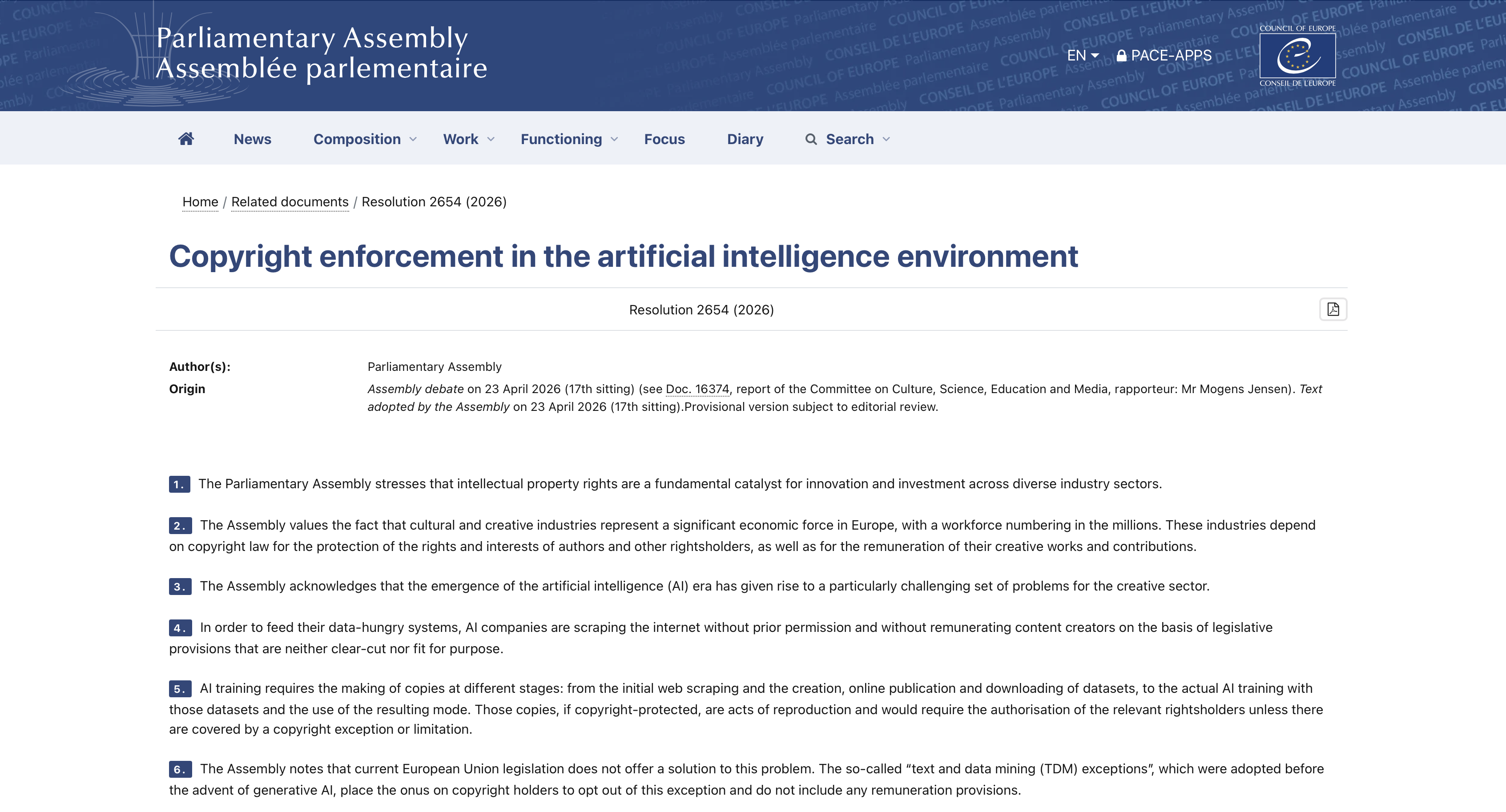
While the 46-nation international organisation PACE, speaking on behalf of 700 million Europeans firmly upholds the values and rights of authors, the EU AI Office persists in its misguided stance on the TDM exception. The EWC calls on the Commission to listen to PACE’s arguments.
Brussels, 29th May 2026
The European Writers’ Council (EWC) expressly welcomes the clear and well-informed resolution “Copyright enforcement in the artificial intelligence environment” (2654), adopted on World Book Day, 23 April 2026, by the Parliamentary Assembly of the Council of Europe (PACE).
Approving the resolution based on the excellent report by Mogens Jensen (Denmark; Committee on Culture, Science, Education and Media; Socialists, Democrats and Greens Group), PACE committed in full to authors’ rights in the era of generative AI, pointing out that the current European legal environment favoured the interests of Big Tech companies in the U.S. and China, while those of authors are marginalised.
“Founded in 1949, the Council of Europe – the oldest intergovernmental institution and independent of decision-makers in Brussels – lives up to its core mission of protecting human rights, democracy, and the rule of law in Europe, and is firmly committed to copyright, authors, and artists”, says Nina George, Commissioner for Political Affairs of the EWC. “It is a refreshing change to have the support of a well-informed and morally incorruptible entity,” confirms Sebastià Portell, EWC President.
The 612 PACE Members, assigned Parliamentarians from the national Governments of each Member State, reminded that innovation shall not be achieved at the expense of creators. PACE demands that Member states require AI-generated output to be clearly labelled in a way that is “machine-readable, interoperable and easily identified by human beings”. Also, the Assembly called on AI providers to “provide transparency of data used for AI training and show openness to dialogue and goodwill in negotiations with rightsholders”.
The EWC especially welcomes:
- Ending unpaid and non-authorised Scraping: PACE stated that feeding copyright-protected works into data-hungry AI systems requires authorisation from rightsholders and shall be remunerated.
- Transparency as key: The Assembly called for strict transparency obligations, demanding that AI providers disclose the datasets and works used to train their models in a title-specific manner.
- Opt-out is no option: PACE stressed that the current legal framework places European authors and further rightsholders at a disadvantage against global tech giants and called upon Member States for clarifying in their national legislation that copyright exceptions such as the text and data mining exceptions introduced by the European Union’s Directive (EU) 2019/790 on copyright and related rights in the Digital Single Market are not applicable to the training of AI systems.
These core points of the adopted resolution follow in full EWC’s ART Principle: Authorisation, Remuneration, Transparency. On behalf of the quarter of a million authors we represent, we would like to thank PACE and applaud the assembly’s decision to prioritise rational arguments rather than defend the marketing rhetoric of dominant tech oligopolies.
The EWC calls on the European Commission and the AI Office to stop willfully ignoring for years the signals given by democratically elected representatives in both PACE and the European Parliament. Practical guidelines and technical workshops should not be developed based on the incorrect assumption that “AI” development is covered by the TDM exception. Both the resolution “On copyright and generative artificial intelligence – opportunities and challenges”, known as the “Voss Report” and the PACE resolution “Copyright enforcement in the artificial intelligence environment” have, independently of one another, reaffirmed the need to stop deliberately overinterpreting the TDM exception and to make an end of the mass exploitation of authors’ labour, work, and investments. You cannot build the truth on a false claim.
About the European Writers’ Council (EWC): The EWC is the world’s largest federation of writers in the book sector and of all genres (fiction, non-fiction, academic, children’s books, poetry, etc.). With 52 organisations and professional guilds from 34 countries of the EU, the EEA and of non-EU areas, the EWC represents 250.000 writers and translators, writing and publishing altogether in 37 languages. The EWC is the world’s leading federation for the defence of book authors’ rights since 1977. www.europeanwriterscouncil.eu
Download this Statement